With Georgia Leaning Toward Russia, Former President Calls for Fresh U.S. Engagement
As Washington tries to move the risk of a broader conflict with Iran into the background through diplomacy, Georgia is urging Western leaders not to lose focus on the Caucasus. The small but strategically important country sits just north of Iran and has become increasingly significant in regional power politics.
At the same time, Georgia’s pro-democracy protesters have remained active for more than 560 days, demonstrating against what they view as the country’s steady democratic decline.
For Georgia’s opposition and civil society groups, any easing of Middle East tensions could give the United States and its allies more room to refocus on Georgia’s internal crisis. They argue that the country is facing growing authoritarian pressure and expanding Russian influence through the ruling political establishment.
Salome Zurabishvili Warns Against Ignoring Georgia
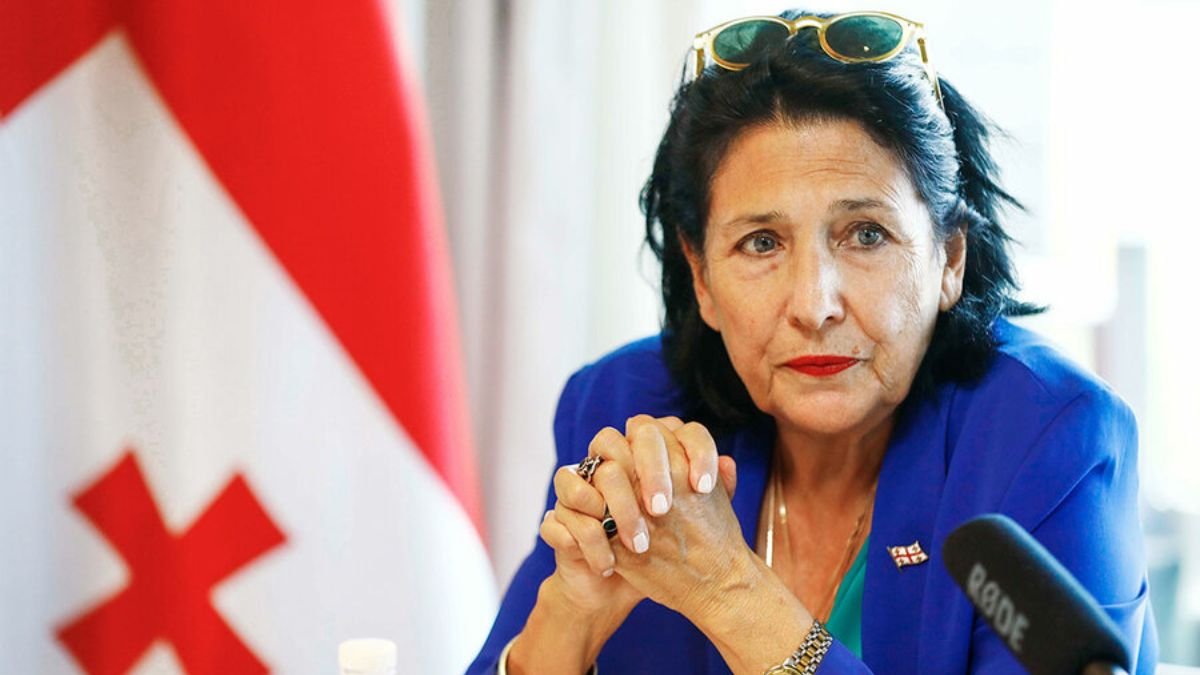
During a June 16 interview in Washington, Georgia’s fifth president, Salome Zurabishvili, warned that Western inattention could effectively hand Georgia over to Moscow’s sphere of influence.
Zurabishvili said Georgia should not be treated as a minor issue on the edge of Europe’s political map. Instead, she argued that Tbilisi is becoming increasingly important to the strategic balance across the Caucasus.
Her remarks came shortly after she received Freedom House’s 2026 Mark Palmer Prize, an honor she said carried major symbolic importance for Georgia’s civil society. After nearly two years of protests and increasing pressure on activists, Zurabishvili said the award showed that Georgian democrats had not been forgotten.
Political Crisis After 2024 Elections
Zurabishvili’s presidential term ended on December 29, 2024, during a deep political crisis. She had refused to recognize the results of the October parliamentary elections and left the presidential palace on the same day her successor was sworn in.
Her latest comments come as the ruling Georgian Dream party attempts to present itself as a necessary regional partner during Middle East instability. The party has also pointed to a recent phone call with U.S. Secretary of State Marco Rubio as a sign of improving relations with Washington.
Zurabishvili rejected that interpretation, describing the move as political performance. She argued that Georgian Dream has tried to lobby in Washington while also maintaining relationships with forces opposed to Western interests.
Georgia Described as a Growing Gray Zone
Zurabishvili said she believes Georgia’s current government no longer follows a truly independent foreign policy. In her view, the ruling party shapes its actions around what Russia will allow.
She described Georgian Dream’s foreign policy as inconsistent and opportunistic, sometimes aligning with countries such as Hungary and Slovakia, while also attempting occasional resets with the United States and the European Union.
However, her biggest concern was not only diplomacy but infrastructure and enforcement. Zurabishvili warned that Georgia is increasingly becoming a “gray zone” where sanctions enforcement, financial oversight, and border controls are difficult to monitor.
She pointed to cases involving foreign nationals obtaining Georgian documents, loosely regulated cryptocurrency activity, and ships connected to Russia’s so-called shadow fleet arriving at Georgian ports.
She also raised concern over more than 100 weekly flights between Georgia and Russia, saying the large volume of movement raises questions about whether enforcement systems can properly track and control activity.
According to Zurabishvili, the danger is not simply crime but strategic vulnerability. She suggested that weak oversight could allow Russian networks and sanctioned actors to exploit Georgia’s systems.
Concerns Over Russia-Style Political Control
Zurabishvili also warned that Georgia’s domestic political environment has deteriorated sharply. She said parliament now functions largely as a rubber stamp, while opposition figures face increasing legal pressure and new laws make dissent more risky.
One of her strongest concerns involves efforts to ban opposition parties through Georgia’s Constitutional Court. Such a move, she argued, could severely reduce political competition before future elections.
She also claimed that hundreds of people she described as prisoners of conscience remain detained. In her view, Georgia’s system is beginning to resemble Russia’s model of political control.
However, Zurabishvili stressed that Georgia remains different from Russia in one important way: its civil society is still active, organized, and willing to resist.
Protest Movement Remains Active
For nearly two years, protesters have continued demonstrating against what they see as Georgia’s movement toward authoritarian rule. Zurabishvili said this resilience is now meeting a changing geopolitical environment.
She pointed to recent action by the U.S. House of Representatives, which passed legislation aimed at countering Russian, Chinese, and Iranian influence across the Caucasus. To her, this suggests Washington may finally be paying closer attention to the region’s shifting power dynamics.
Still, Zurabishvili questioned why legislation was necessary for the West to recognize the urgency of the problem.
Hybrid Threats and Political Instability
Zurabishvili argued that while Western countries have adapted to Russia’s military threat, they remain behind in responding to the Kremlin’s hybrid tactics. These include disinformation, political influence operations, economic pressure, and the use of artificial intelligence to interfere in democratic systems.
Looking ahead, she suggested that Georgian Dream could be entering a more unstable period. She pointed to arrests within the ruling party’s own ranks and signs of political anxiety as possible evidence that confidence inside the party is weakening.
She also said Russia’s image has changed because President Vladimir Putin no longer appears as strong in Europe as he once did.
Possible Snap Elections and Opposition Challenges
Zurabishvili warned that this political uncertainty could increase the chance of early elections in Georgia. However, she also cautioned that the opposition remains divided and may not yet be fully prepared for such a contest.
To challenge what she sees as a consolidated authoritarian system, she said Georgia’s opposition needs more than standard electoral competition. In her view, it needs a broader united national front.
For Salome Zurabishvili, Georgia’s democratic future must ultimately be decided by Georgians. However, she believes Western allies have a responsibility to recognize the wider strategic importance of the country.
If Iran moves lower on Washington’s foreign policy agenda, she argues, the Caucasus could become the next major test of Western resolve. Georgia, positioned between competing regional powers and facing internal democratic pressure, may prove far more central to future geopolitical struggles than many Western leaders currently realize.