Georgia State Lawmakers Abandon Redistricting Effort
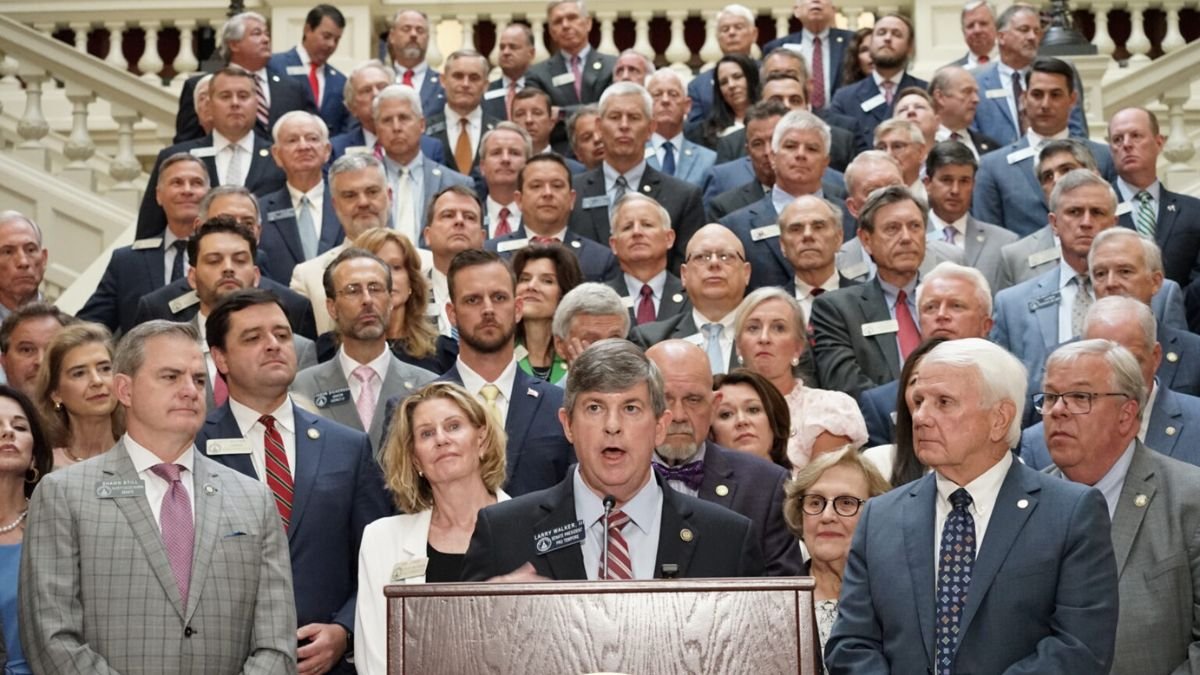
Republican leaders in the Georgia House of Representatives and the Georgia state Senate have said they will not move forward with redrawing the state’s political maps during the special legislative session that began Wednesday.
Their decision comes amid ongoing legal challenges and uncertainty surrounding recent court rulings on redistricting and the Voting Rights Act.
In a letter to Georgia Governor Brian Kemp, House Speaker Jon Burns and other House Republican leaders said they believe Georgia will succeed in pending appeals. They also said lawmakers should wait for more court guidance before making future decisions about district maps.
House Leaders Call for Public Input
Burns and the House leadership team argued that changes to Georgia’s maps should only happen after lawmakers and residents have enough time to review the facts, share opinions, and take part in meaningful debate.
Because of that, they said the House will not take up congressional or legislative redistricting for the 2028 election cycle during the current special session.
The message emphasized that map changes affect voters across the state and should not be handled through a rushed process.
Senate Also Rejects Redistricting During Session
The Georgia Senate took a similar position. In a Wednesday afternoon statement, Senate President Pro Tem Larry Walker said the Senate had also sent a letter to Kemp explaining that it would not consider redistricting during the special session.
Walker said it would be wiser to let the judicial process continue in other states and carefully examine how courts respond to newly adopted district maps across the country.
He added that with more legal guidance, Georgia’s future districts would be better positioned to survive court scrutiny.
Senate Says Redistricting Should Not Be Rushed
Walker also noted that any changes to Georgia’s congressional or legislative districts would not take effect until the 2028 election cycle. Because of that, Senate leaders believe the state should move carefully rather than quickly.
He said any redistricting action should be transparent, well-informed, and coordinated with the Georgia House.
Brian Kemp Says Delay Is Not Necessary
Governor Brian Kemp responded by saying he does not believe the redistricting process needs to be delayed. However, he acknowledged that drawing legislative districts is ultimately the responsibility of the General Assembly.
Kemp pointed to the U.S. Supreme Court’s decision in Louisiana v. Callais, saying the ruling reaffirmed that racial gerrymandering is unconstitutional in every form.
He said Georgia’s legislative maps were intentionally drawn to create majority-minority districts, a practice he argued has now been ruled unconstitutional.
At the same time, Kemp noted that the General Assembly had failed to pass legislation addressing a self-imposed deadline related to Georgia’s election system. That issue required lawmakers to return for a special session before July 1, 2026.
Georgia Was Expected to Join Southern Redistricting Push
Georgia had been viewed as the next major Southern state where Republicans might redraw voting districts after the Supreme Court weakened important Voting Rights Act protections.
Those protections had helped shape existing district boundaries in racially diverse states by requiring maps that gave minority voters a fair chance to elect candidates of their choice.
The special session was called by Kemp following the Supreme Court’s Louisiana v. Callais decision, which struck down Louisiana’s congressional map as an illegal racial gerrymander.
Kemp Took a Different Approach From Other Governors
Unlike some Republican governors who moved quickly to redraw congressional maps for the upcoming November midterm elections, Kemp wanted Georgia lawmakers to focus on districts for 2028 instead.
This was partly different from the strategy encouraged by President Donald Trump, who urged Republican-led states to redraw maps quickly to help protect the party’s narrow majority in Congress.
Kemp also went further than some other Southern governors by asking Georgia’s Republican-controlled legislature to consider redrawing its own state legislative districts.
If Georgia had moved forward, it could have become the first state to apply the Callais ruling directly to its legislature, showing how widely the Supreme Court decision could affect Southern states with large Black populations and significant numbers of Black lawmakers.
Georgia’s Civil Rights History Adds Weight to the Debate
The redistricting issue carries special meaning in Georgia. The state Capitol complex includes a statue of Rev. Martin Luther King Jr. and sits only blocks from places connected to his life, ministry, and leadership in the civil rights movement.
That movement helped produce the Voting Rights Act of 1965, making Georgia’s debate over minority voting power especially significant.
As of Wednesday morning, neither Kemp nor Republican legislative leaders had publicly released proposed map changes.
Supreme Court Shifted Redistricting Standards
Before the Callais ruling, Section 2 of the Voting Rights Act was widely understood to require congressional, state, and local maps that gave historically marginalized minority communities a reasonable opportunity to elect candidates they supported.
These districts, often called opportunity districts, have disproportionately helped elect Black and other nonwhite candidates in Georgia and across the country.
In Georgia, about one-third of the state’s 180 representatives are Black. When Latino, Asian, and other minority lawmakers are included, nonwhite legislators make up about 40% of the state House, roughly matching Georgia’s overall population.
Georgia’s U.S. House delegation also includes five districts out of 14 where the electorate is majority or plurality nonwhite. All five elected Black Democrats in 2024.
Conservative Majority Calls for Race-Neutral Maps
In the Callais decision, the Supreme Court’s conservative majority ruled that districts drawn with racial makeup in mind are discriminatory and violate the Constitution’s equal protection clause.
The justices said district lines should be drawn in a race-neutral way.
While the ruling focused on race rather than party politics, partisan gerrymandering remains legally allowed under federal court precedent. In many Southern states, however, race and party preference are closely connected, with many nonwhite voters supporting Democrats and many white voters supporting Republicans.
Because of that, critics argue the decision gives Republican-led legislatures room to redraw maps in ways that strengthen GOP seats by spreading out or concentrating nonwhite voters.
Civil Rights Advocates Warn of Hidden Racial Impact
Many civil rights advocates and election experts argue that it is extremely difficult for Southern legislatures to draw maps that are truly race neutral, given the close link between race, geography, and party politics.
Carol Anderson, a professor at Emory University and a board member of Fair Fight Action, compared the effects of the ruling and redistricting push to Jim Crow-era policies such as poll taxes and literacy tests.
She argued that those systems also used neutral-sounding language while targeting Black voters in practice.
Political Risks for Georgia Republicans
Even if Republicans eventually redraw Georgia’s maps, the outcome may not be guaranteed to benefit them.
Partisan gerrymandering usually works by either packing certain voters into fewer districts or spreading them across more districts. Around metro Atlanta, Republicans could try to spread nonwhite and Democratic-leaning voters across additional districts to make more seats appear competitive or Republican-leaning.
However, that strategy carries risks. White suburban and metropolitan voters in Georgia have become less reliably conservative, meaning new maps could accidentally create more battleground districts where Democratic candidates of any race could win.
That risk may be especially important for Georgia’s state House and U.S. House districts, even if the state Senate is already considered more favorable to Republicans.
Kemp’s request would have required many Republican lawmakers, especially those in metro Atlanta, to redraw their own districts and potentially take on unfamiliar voters.
Trump Sparked Wider National Redistricting Fight
The current redistricting fight did not begin with the Supreme Court ruling alone. Nationally, the battle intensified last year when Trump pushed Republican-controlled states to redraw congressional districts to strengthen the GOP’s narrow U.S. House majority before November.
Texas was the first state to respond to Trump’s call.
In response, California Governor Gavin Newsom and Democrats in Sacramento moved forward with their own gerrymander, which voters later approved. Other states then followed with their own efforts.
The national balance could have been closer if the conservative-controlled Virginia Supreme Court had not struck down new Democratic-drawn maps approved by voters.
Redistricting Could Shape Congress Beyond 2026
Republicans believe their redistricting efforts could help them gain as many as 16 seats, while Democrats believe they could pick up about six seats from new districts in California and Utah.
Even that may not be enough for Republicans to guarantee control of the House, especially with Trump’s approval ratings lagging. However, the strategy could reduce Democratic gains and give Republicans a stronger position heading into 2028 and future elections.
Georgia Republican leaders have chosen not to redraw congressional or legislative maps during the current special session, despite pressure from the Supreme Court’s Louisiana v. Callais ruling and broader Republican efforts to reshape districts nationwide. House and Senate leaders said they want more legal clarity, public input, and a deliberate process before making changes that could affect voters across the state. While Governor Brian Kemp argued there is no need to delay, lawmakers have decided to wait, leaving Georgia’s redistricting battle unresolved as legal, political, and civil rights questions continue to develop.